25 Kasım 2012 Pazar

Hurricane Sandy's Transformation

To contact us Click HERE
A lot has been said of the severe damage that may accompany Hurricane Sandy---10-20 inches of precipitation west and southwest of the storm, coastal wind gusts exceeding 80 mph, severe damage to barrier beaches, flooding over western L.I. sound and other vulnerable locations.  The threat is great and imminent.

But what has not been discussed in depth is the extraordinary transformation that will occur as Sandy makes landfall and moves inland....from a tropical to an extratropical storm, the first with a warm core and the latter with a cold core.  I will talk about that here.

Right now Hurricane Sandy is almost exactly one day from landfall on New Jersey.  It possesses sustained winds of 75 mph and a central pressure of 950 hPa, and is very large storm and will expand even more.  Here is a recent infrared image, showing the band of moisture feeding into the center of the storm.


As I have mentioned before, hurricanes and tropical storms derive their energy from the warmth and moisture of warm oceans, and Sandy is no exception.  Such tropical storms are warm-core systems, with the warmest air in their centers.  In general, tropical storms are not found in regions with large horizontal changes in temperature.

 Recently, there has been a substantial warm anomaly of the sea surface temperature (SST) of the western Atlantic (SST much warmer than normal), which helps tropical systems like Sandy move northward and stay strong longer than normal.  Here is a recent map showing the SST anomaly:  much warmer than normal along the path of Sandy, by over 1.5C!  So a very attractive welcome mat had been laid for tropical storms over the western Atlantic.


Now midlatitude or extratropical storms get their energy not from warm oceans, but rather horizontal temperature changes---generally warmer to the south, cooler to the north.  It turns out that the temperature changes on our planet are concentrated in the midlatitudes...and this temperature gradient fuels nearly all of the storms we experience in the winter.  Midlatitude storms tend to be cold-core, with the coolest temperatures in their center.

Sometimes a tropical storm moves northward and undergoes an amazing transformation, from a warm core tropical system to a cold-core extratropical system, and switches its energy supply from the warmth and moisture of a tropical ocean to the temperature gradients of the midlatitudes.  This is called Extratropical Transition (ET) in the business.

Sandy is about to go through the transformation.

Let me show you.  The figures below show you the temperatures and pressure pattern (actually heights of the 850 hPa pressure surface) at around 5000 ft above sea level for three times (Monday morning, Monday evening, and Tuesday morning--Seattle Time).  At the initial time there is warm air at the center of the storm (the dark orange color).  Fairly symmetric structure (which is typical of tropical systems).


By tomorrow evening, just as the storm is making landfall,  the warm core is fading, and temperature structure is becoming much more asymmetric.

 By Tuesday morning, the transformation is complete....cold air has reached the center of the storm and the warmest air is found far to the east of the center


Many tropical storms weaken when they go through this transition, but for a small subset the opposite occurs.   The two energy sources work synergistically for a while, resulting in an strengthening and expanding system....such is the forecast fate of Sandy.

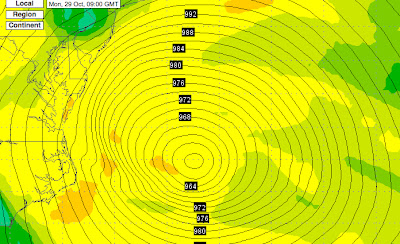
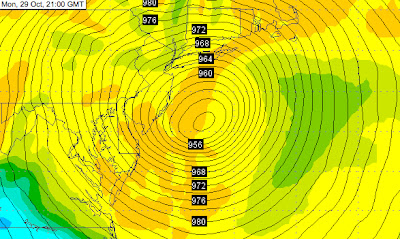
In fact, during this transition stage, Sandy will continue to intensity until it makes landfall.  Here is the latest forecast from the NWS NAM model:

956 hPa low center at 2 AM Monday morning (PDT)

12 hours later 948 hPa pressure (2 PM Seattle Time).

My next blog will take a look at the scorecard for this storm....and return to talking about Northwest weather.  And there is a lot to talk about, including an atmospheric river situation setting up and 5-10 inches forecast over the next 72 hr over NW mountains.


24 Kasım 2012 Cumartesi

Hurricane Sandy's Transformation

To contact us Click HERE
A lot has been said of the severe damage that may accompany Hurricane Sandy---10-20 inches of precipitation west and southwest of the storm, coastal wind gusts exceeding 80 mph, severe damage to barrier beaches, flooding over western L.I. sound and other vulnerable locations.  The threat is great and imminent.

But what has not been discussed in depth is the extraordinary transformation that will occur as Sandy makes landfall and moves inland....from a tropical to an extratropical storm, the first with a warm core and the latter with a cold core.  I will talk about that here.

Right now Hurricane Sandy is almost exactly one day from landfall on New Jersey.  It possesses sustained winds of 75 mph and a central pressure of 950 hPa, and is very large storm and will expand even more.  Here is a recent infrared image, showing the band of moisture feeding into the center of the storm.


As I have mentioned before, hurricanes and tropical storms derive their energy from the warmth and moisture of warm oceans, and Sandy is no exception.  Such tropical storms are warm-core systems, with the warmest air in their centers.  In general, tropical storms are not found in regions with large horizontal changes in temperature.

 Recently, there has been a substantial warm anomaly of the sea surface temperature (SST) of the western Atlantic (SST much warmer than normal), which helps tropical systems like Sandy move northward and stay strong longer than normal.  Here is a recent map showing the SST anomaly:  much warmer than normal along the path of Sandy, by over 1.5C!  So a very attractive welcome mat had been laid for tropical storms over the western Atlantic.


Now midlatitude or extratropical storms get their energy not from warm oceans, but rather horizontal temperature changes---generally warmer to the south, cooler to the north.  It turns out that the temperature changes on our planet are concentrated in the midlatitudes...and this temperature gradient fuels nearly all of the storms we experience in the winter.  Midlatitude storms tend to be cold-core, with the coolest temperatures in their center.

Sometimes a tropical storm moves northward and undergoes an amazing transformation, from a warm core tropical system to a cold-core extratropical system, and switches its energy supply from the warmth and moisture of a tropical ocean to the temperature gradients of the midlatitudes.  This is called Extratropical Transition (ET) in the business.

Sandy is about to go through the transformation.

Let me show you.  The figures below show you the temperatures and pressure pattern (actually heights of the 850 hPa pressure surface) at around 5000 ft above sea level for three times (Monday morning, Monday evening, and Tuesday morning--Seattle Time).  At the initial time there is warm air at the center of the storm (the dark orange color).  Fairly symmetric structure (which is typical of tropical systems).


By tomorrow evening, just as the storm is making landfall,  the warm core is fading, and temperature structure is becoming much more asymmetric.

 By Tuesday morning, the transformation is complete....cold air has reached the center of the storm and the warmest air is found far to the east of the center


Many tropical storms weaken when they go through this transition, but for a small subset the opposite occurs.   The two energy sources work synergistically for a while, resulting in an strengthening and expanding system....such is the forecast fate of Sandy.

In fact, during this transition stage, Sandy will continue to intensity until it makes landfall.  Here is the latest forecast from the NWS NAM model:

956 hPa low center at 2 AM Monday morning (PDT)


12 hours later 948 hPa pressure (2 PM Seattle Time).


My next blog will take a look at the scorecard for this storm....and return to talking about Northwest weather.  And there is a lot to talk about, including an atmospheric river situation setting up and 5-10 inches forecast over the next 72 hr over NW mountains.


Multiple-Car Collisions and Weather: Can We Stop the Carnage?

To contact us Click HERE
It has became an all too frequent news item:  dozens or hundreds of cars involved in a huge pile up on some freeway or interstate.  Dozens injured and several deaths.  Tales of terror.  Major roadways closed for extended period, with huge attendant cost.  And most are associated with a reduction of visibility due to some weather phenomenon:  heavy rain, fog, snow burst, smoke, or dust.

It happened again yesterday (Thanksgiving morning) on I10 near Beaumont, Texas and was associated with dense fog.  Nearly 150 vehicles, 2 deaths, over 50 people sent to hospitals.  Tales of screaming and narrow escape.  And such event don't have to happen.

A portion of the Thanksgiving morning I10 accident.
Such multi-car collisions have happened on many occasions here in Washington State and I believe that new weather and communication technology can substantially reduce their frequency.

First, lets talk about the "set up" for these disasters.  Generally, they occur on freeways and interstates where folks are moving fast with substantial traffic volumes.  Drivers are moving relatively close, many with insufficient following distance.  One vehicle enters a zone of reduced visibility due to one of a variety of factors:

(1) Dense fog
(2) Smoke from a nearby fire
(3) Dust storm due to strong winds over plowed, bare agricultural fields
(4) Heavy rain.
(5) Intense road glare when the vehicle exits a rain area into bright sunlight.

The driver slams on the breaks when he/she loses visibility and then other vehicles, too close to stop, crash into the first vehicle.  Vehicle after vehicle crashes into the growing pile up.

You can search news using google and bing and you will find hundreds of examples of such weather-related multiple car accidents.


How do we stop these disasters?   

 I know, a big issue is that drivers often follow too close and too fast for the weather conditions (or ANY condition).  Perhaps we need more vigorous laws about following distance and speed limits that depend on weather conditions.   It will be difficult to enforce, but I am certainly willing to see some action in this direction.

But there are some technical solutions that are possible, particularly now that we have massive amounts of weather information available, many folks have smartphones, there are reader boards and flow control on a number of highways, and soon many cars will have internet capability.

Consider an example.  There have been a number of big accident pile ups here in Washington as a heavy convective cell crossed I5 late in the afternoon.  Drivers here are used to rain, so they keep their speed up (probably too fast).  Then they exit the convective precipitation and bright sunshine reflecting off the bright roadway blinds a driver who slows abruptly.  A big chain reaction accident ensues.

We can reduce the number of these events.  We have radar imagery that can be used to predict when heavy rainfall will cross the road during the next hour.  We know where the sun is and whether clouds will block the sun.  It would be easy to determine if a risk exists or WILL exist soon.  I5 has lots of reader boards that could warn drivers to slow down-- in fact, they can even change the speed limit in real time.  This could have a huge impact on stopping such urban pile ups.  I put in a proposal to WSDOT to build such a capability...wasn't funded unfortunately.


What about smoke or fog on the roads?   We have satellite imagery that provides a real-time view of the distribution of these hazards.  Here is an example of "fog imagery) for the accident area yesterday.


And satellite imagery can show dust storms as well.  Here is one associated with a major collision event in eastern WA.


And there are huge numbers of surface observing stations located on or near highways.

 Imagine a real-time system that looks for roadway threats, sends information to all available electronic signs, and sends messages to smartphones in the area?   Folks could load a special warning app on their smartphones that would tell them when a serious threat is in front of them. (calling all weather app developers!)   Eventually (in a few years), nearly all cars will have internet capability and the warnings could be shown on the instrument panel.

There are the collision prevention systems going into high-end cars these days that monitor following distance and automatically brake the car if a collision is imminent.   That could help.  Even more futuristic we could consider having the car slow down automatically during bad weather, either from information derived from sensors on the car or information it receives via the net).   Perhaps insurance companies will give a discount to folks with this new system on their vehicle.

Bottom line:  the marriage of dense weather observations and weather imagery with new communications/control technologies can greatly reduce the frequency of multiple car pile ups...and there is a lot we could do today at modest cost.


23 Kasım 2012 Cuma

Hurricane Sandy's Transformation

To contact us Click HERE
A lot has been said of the severe damage that may accompany Hurricane Sandy---10-20 inches of precipitation west and southwest of the storm, coastal wind gusts exceeding 80 mph, severe damage to barrier beaches, flooding over western L.I. sound and other vulnerable locations.  The threat is great and imminent.

But what has not been discussed in depth is the extraordinary transformation that will occur as Sandy makes landfall and moves inland....from a tropical to an extratropical storm, the first with a warm core and the latter with a cold core.  I will talk about that here.

Right now Hurricane Sandy is almost exactly one day from landfall on New Jersey.  It possesses sustained winds of 75 mph and a central pressure of 950 hPa, and is very large storm and will expand even more.  Here is a recent infrared image, showing the band of moisture feeding into the center of the storm.


As I have mentioned before, hurricanes and tropical storms derive their energy from the warmth and moisture of warm oceans, and Sandy is no exception.  Such tropical storms are warm-core systems, with the warmest air in their centers.  In general, tropical storms are not found in regions with large horizontal changes in temperature.

 Recently, there has been a substantial warm anomaly of the sea surface temperature (SST) of the western Atlantic (SST much warmer than normal), which helps tropical systems like Sandy move northward and stay strong longer than normal.  Here is a recent map showing the SST anomaly:  much warmer than normal along the path of Sandy, by over 1.5C!  So a very attractive welcome mat had been laid for tropical storms over the western Atlantic.


Now midlatitude or extratropical storms get their energy not from warm oceans, but rather horizontal temperature changes---generally warmer to the south, cooler to the north.  It turns out that the temperature changes on our planet are concentrated in the midlatitudes...and this temperature gradient fuels nearly all of the storms we experience in the winter.  Midlatitude storms tend to be cold-core, with the coolest temperatures in their center.

Sometimes a tropical storm moves northward and undergoes an amazing transformation, from a warm core tropical system to a cold-core extratropical system, and switches its energy supply from the warmth and moisture of a tropical ocean to the temperature gradients of the midlatitudes.  This is called Extratropical Transition (ET) in the business.

Sandy is about to go through the transformation.

Let me show you.  The figures below show you the temperatures and pressure pattern (actually heights of the 850 hPa pressure surface) at around 5000 ft above sea level for three times (Monday morning, Monday evening, and Tuesday morning--Seattle Time).  At the initial time there is warm air at the center of the storm (the dark orange color).  Fairly symmetric structure (which is typical of tropical systems).


By tomorrow evening, just as the storm is making landfall,  the warm core is fading, and temperature structure is becoming much more asymmetric.

 By Tuesday morning, the transformation is complete....cold air has reached the center of the storm and the warmest air is found far to the east of the center


Many tropical storms weaken when they go through this transition, but for a small subset the opposite occurs.   The two energy sources work synergistically for a while, resulting in an strengthening and expanding system....such is the forecast fate of Sandy.

In fact, during this transition stage, Sandy will continue to intensity until it makes landfall.  Here is the latest forecast from the NWS NAM model:

956 hPa low center at 2 AM Monday morning (PDT)


12 hours later 948 hPa pressure (2 PM Seattle Time).


My next blog will take a look at the scorecard for this storm....and return to talking about Northwest weather.  And there is a lot to talk about, including an atmospheric river situation setting up and 5-10 inches forecast over the next 72 hr over NW mountains.


22 Kasım 2012 Perşembe

Hurricane Sandy's Transformation

To contact us Click HERE
A lot has been said of the severe damage that may accompany Hurricane Sandy---10-20 inches of precipitation west and southwest of the storm, coastal wind gusts exceeding 80 mph, severe damage to barrier beaches, flooding over western L.I. sound and other vulnerable locations.  The threat is great and imminent.

But what has not been discussed in depth is the extraordinary transformation that will occur as Sandy makes landfall and moves inland....from a tropical to an extratropical storm, the first with a warm core and the latter with a cold core.  I will talk about that here.

Right now Hurricane Sandy is almost exactly one day from landfall on New Jersey.  It possesses sustained winds of 75 mph and a central pressure of 950 hPa, and is very large storm and will expand even more.  Here is a recent infrared image, showing the band of moisture feeding into the center of the storm.


As I have mentioned before, hurricanes and tropical storms derive their energy from the warmth and moisture of warm oceans, and Sandy is no exception.  Such tropical storms are warm-core systems, with the warmest air in their centers.  In general, tropical storms are not found in regions with large horizontal changes in temperature.

 Recently, there has been a substantial warm anomaly of the sea surface temperature (SST) of the western Atlantic (SST much warmer than normal), which helps tropical systems like Sandy move northward and stay strong longer than normal.  Here is a recent map showing the SST anomaly:  much warmer than normal along the path of Sandy, by over 1.5C!  So a very attractive welcome mat had been laid for tropical storms over the western Atlantic.


Now midlatitude or extratropical storms get their energy not from warm oceans, but rather horizontal temperature changes---generally warmer to the south, cooler to the north.  It turns out that the temperature changes on our planet are concentrated in the midlatitudes...and this temperature gradient fuels nearly all of the storms we experience in the winter.  Midlatitude storms tend to be cold-core, with the coolest temperatures in their center.

Sometimes a tropical storm moves northward and undergoes an amazing transformation, from a warm core tropical system to a cold-core extratropical system, and switches its energy supply from the warmth and moisture of a tropical ocean to the temperature gradients of the midlatitudes.  This is called Extratropical Transition (ET) in the business.

Sandy is about to go through the transformation.

Let me show you.  The figures below show you the temperatures and pressure pattern (actually heights of the 850 hPa pressure surface) at around 5000 ft above sea level for three times (Monday morning, Monday evening, and Tuesday morning--Seattle Time).  At the initial time there is warm air at the center of the storm (the dark orange color).  Fairly symmetric structure (which is typical of tropical systems).


By tomorrow evening, just as the storm is making landfall,  the warm core is fading, and temperature structure is becoming much more asymmetric.

 By Tuesday morning, the transformation is complete....cold air has reached the center of the storm and the warmest air is found far to the east of the center


Many tropical storms weaken when they go through this transition, but for a small subset the opposite occurs.   The two energy sources work synergistically for a while, resulting in an strengthening and expanding system....such is the forecast fate of Sandy.

In fact, during this transition stage, Sandy will continue to intensity until it makes landfall.  Here is the latest forecast from the NWS NAM model:

956 hPa low center at 2 AM Monday morning (PDT)


12 hours later 948 hPa pressure (2 PM Seattle Time).


My next blog will take a look at the scorecard for this storm....and return to talking about Northwest weather.  And there is a lot to talk about, including an atmospheric river situation setting up and 5-10 inches forecast over the next 72 hr over NW mountains.


Intense Convective Line

To contact us Click HERE
Sometimes a weather feature comes through that grabs your attention, providing a sobering reminder of the power of the natural world.  Yesterday, we got hit by such a feature--an intense convective line that brought strong winds, intense rain, and a cloud feature that was nearly biblical in appearance.

First, a picture, graciously provided to us by Peter Loron, of the line as it was approaching downtown Seattle (time: 1:30 PM Thursday).  Looks like the end of the world.   

Picture courtesy of Peter Loron.  Looking towards W. Seattle from downtown.
Would have been fun to be on the big white wheel! Or scary.
 Another view of the line was provided by Paul Gockel, taken mid-span on the 520 bridge:

Picture courtesy of Paul Gockel
You see that linear appendage hanging below the main cloud base? Those threatening clouds (also known as shelf clouds) are found along the leading edge of the gust front;  cool air descends out of the cumulonimbus cloud and forces air in front of it to rise, producing the cloud  (see schematic below).

Schematic of gust front and shelf cloud
 For your viewing pleasure, here is another dramatic shelf cloud.

We could see the convection (big line of cumulonimbus clouds) in the Camano Island radar image at nearly the same time (yellow is heavy rain, red is VERY heavy rain or hail).


There was one lone lightning strike (over north Seattle as this feature went through).

As it went past the UW, the winds gusted to 30 kts, the wind directed shifted to southwesterly, heavy rain fell, pressure jumped, and temperature fell (look just past 21z on the UW rooftop observation plot below).

Or you could view the system from the cam on the roof of my building.  Here are images before, during, and after passage of this line:


One interesting aspect of this feature is one could follow it from offshore, using the Langley Hill radar.   Here is an image at 10:48 AM Tuesday...clearly apparent offshore.


Hopefully, during the next year we can extend Seattle RainWatch to include the Langley radar to provide an automated heads up for features such as this one.